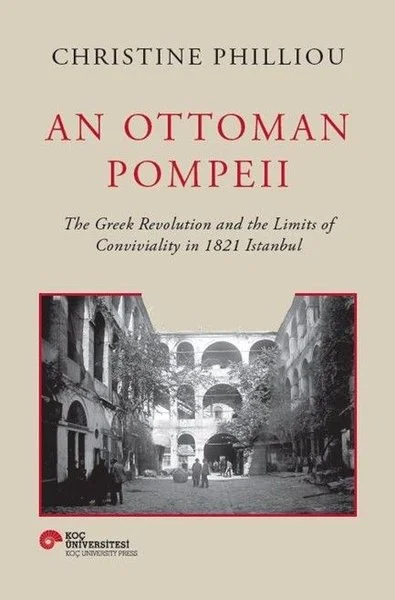
An Ottoman Pompeii - The Greek Revolution and The Limits of Conviviality in 1821 Istanbul (Ciltli)
At the outbreak of what would become known as the Greek Revolution, and what Ottoman authorities confronted as a Greek insurgency, Istanbul became the stage for a crisis that would reshape the Ottoman Empire and the eastern Mediterranean. An Ottoman Pompeii: The Greek Revolution and the Limits of Conviviality in 1821 Istanbul uncovers this moment through an extraordinary population register compiled in spring and early summer 1821, just as rebellion, reprisal, suspicion, and imperial surveillance converged in the capital.
Christine Philliou treats this register as a time capsule: a granular record of more than 1300 non-Muslim residents Orthodox Christians, Armenians, and Jews whose world emerges above all through Istanbul's hans and their rooms, as well as through their neighborhoods, occupations, origins, and networks. Like Pompeii, preserved by catastrophe, the register freezes an urban world at the instant of rupture. It reveals not only the violence and fear surrounding the imperial response to revolt, but also the everyday coexistence, labor, migration, and social intimacy that still bound Istanbul's communities together. By including a verbatim transliteration of the register, An Ottoman Pompeii also opens this remarkable source to further research, enabling scholars to trace new patterns of urban life, labor, migration, coexistence, and rupture in the Ottoman capital.
Moving between Ottoman imperial history and the emergence of Greek national history, An Ottoman Pompeii offers a new way of seeing the city before modern categories hardened: as a dense, fragile, and interconnected world whose traces were recorded at the very moment its foundations were beginning to fracture.
Christine Philliou is Professor in the Department of History at University of California Berkeley and Director of the Modern Greek/Hellenic Studies and Turkish, Ottoman and Post-Ottoman Studies (TOPOS) programs there.
Transliteration Editor: Elias Kolovos
Data analysis and visualizations: FiruzanMelike Sümertaş
(Tanıtım Bülteninden)
| Taksit Sayısı | Taksit tutarı | Genel Toplam |
|---|---|---|
| Tek Çekim | 780,00 | 780,00 |
-
-
%35İNDİRİM300,00TL 195,00TL

-
%35İNDİRİM650,00TL 422,50TL
-
%35İNDİRİM300,00TL 195,00TL
-
%35İNDİRİM900,00TL 585,00TL
-
-
%35İNDİRİM300,00TL 195,00TL
-
%35İNDİRİM300,00TL 195,00TL
-
-
-
%35İNDİRİM240,00TL 156,00TL
-
%35İNDİRİM300,00TL 195,00TL